


Blog
Your Complete Guide To Color Grading Lab Grown Diamonds
09 Sep 2025
Color grading forms a fundamental part when judging the quality, beauty, and value of a diamond, with the aspect of either being mined or lab-made. While a lab-grown diamond shares the same chemical and optical features as its natural counterpart, its evaluation processes, including the grading lab grown diamonds, are executed on the same stringent criteria of the gemstone industry. This guide, therefore, sets off into the basics of lab grown diamond color chart for lab-grown diamonds, how it is done, and why it is important to both consumers and jewelers.
Understanding Grading Lab Grown Diamonds
The term lab diamond color chart refers to the presence or absence of color in a white diamond. Colored diamonds, such as blue and pink stones, have a different grading system, whereas white (or colorless) diamonds are graded on how little color they emit. The less color a diamond has, the more premium it gets on the standard color scale developed by the Gemological Institute of America (GIA).
This scale runs from D, being colorless, to Z, being light yellow or brown. D-grade diamonds are very rare and hence more costly. As one goes down the color scale, the diamonds start showing faint yellow or brown shadows that further affect their appearance and price.
Why Color Matters
A diamond's look and value are significantly affected by its colour. While diamonds with lower grades may have a warm colour that affects the overall look, colourless diamonds often reflect more light and glitter more brilliantly. Colour becomes a crucial factor for buyers seeking appearances that are brilliant, clear, and pure.
Colour differences occur even in lab-grown diamonds, where defects in structure and contaminants may be managed throughout the growing process. These variations result from minute trace elements or minute variations in the diamond's formation circumstances.
How to Grading Lab Grown Diamonds
Lab-grown diamonds are color graded in the same way as mined diamonds, utilizing standardized equipment and expert professional judgment. This is how the process is typically conducted:
Visual Comparison
The gemologist compares the lab-grown diamond to master stones with known color grades. The comparisons are made under controlled lighting conditions with specialized lighting equipment and neutral backgrounds.
Use of Master Stones
Master stones are particular points on the color scale. These stones are used in conjunction with the diamond being graded to see where it lies on the spectrum. Small variations can make a difference in the grade.
Magnification and Lighting Tools
Grading is conducted under magnification and daylight equivalent lighting to be as accurate as possible. Any hues or tints, even small amounts, become apparent under these conditions.
Multiple Evaluations
For the purpose of objectivity, multiple gemologists can evaluate the diamond. In case of discrepancies, a final conclusion is derived by further inspection.
The GIA Color Scale Explained
Following is a description of the GIA grading scale, which is widely accepted for both earth-mined and lab-grown diamonds:
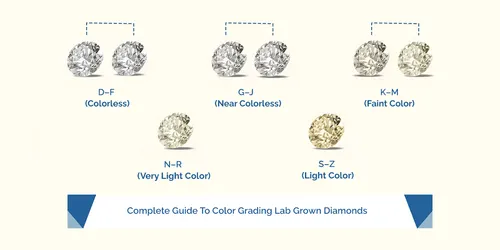
D–F (Colorless): These are diamonds that have almost no color. They are of the highest color quality and command a good price accordingly.
G–J (Near Colorless): Only a slight trace of color is visible when compared to a higher grade diamond. These diamonds provide a good compromise between appearance and price.
K–M (Faint Color): A perceptible tint becomes more apparent. These diamonds cost less and are usually set in yellow gold to hide their color.
N–R (Very Light Color): Color can be viewed easily by the naked eye. They are not used as frequently in fine jewelry.
S–Z (Light Color): These diamonds have a light yellow or brown color. They are normally applied to industrial purposes or very unique jewelry designs.
How Important Is a Diamond's Color?
Color can be a highly significant consideration when choosing your ideal diamond. Not only does the color grade impact the value of a diamond, but it also has a great influence on its appearance. While icy, colorless diamonds have been the most desirable historically, modern couples tend to choose a diamond with a warmer hue since it can show an individual and classic appearance.
Once again, getting the ideal diamond for you will be a matter of finding the ideal combination of the 4 C's and your pocket. If color is what matters the most to you, you might have to compromise on carat weight, cut, or clarity. Or vice versa, if carat weight, cut, or clarity matters the most, choosing a near-colorless diamond can be more convenient than a colorless one. Lumex offers the best lab grown diamonds in India.
Selecting the Right Color Grade
In choosing a lab-grown diamond, the optimal color grade is usually a matter of personal taste, budget, and planned setting. Here are some general gia graded lab diamonds guidelines:
For clients who want a luxury look, diamonds in the D–F range provide the cleanest appearance.
For shoppers who want a nearly perfect appearance at a lower price, the G–H range provides great value.
Diamonds with a grade of I–J are still white to the naked eye of most people and are an excellent budget-friendly choice.
If it is placed in yellow or rose gold, a lower color grade (K–M) can be less conspicuous and cheaper.
Conclusion
Color grading is an important part of selecting a lab grown diamond. The color affects both the attractiveness and value of the diamond, determining how it reflects light and interacts with the rest of the jewelry. As much as the higher graded diamonds (D-F) contain uncompromising clarity and brilliance, diamonds graded G -J can be of incredible beauty at a lower cost.
The 4Cs of diamonds - carat, color, clarity, and cut - are the key factors that determine the quality and value of a diamond. When selecting a diamond, consider the setting, cut, carat, and metal to ensure the color grade complements the overall design. If you are uncertain, consulting with a diamond expert can provide valuable insights and help you make an informed decision. Keep in mind, however, that the finest diamond is the one that suits your individual taste and budget, but also sparkles in any light.
Explore our other articles such as Are Lab Grown Diamonds A Smart Investment?
FAQ
1. What is color grading in lab-grown diamonds?
Color grading is the evaluation of the amount of color in a white (colorless) lab-grown diamond. The lower the color of the diamond, the higher the grade on the GIA scale (D-Z). Color grading determines the appeal of the diamond visually and in the market.
2. Are lab-grown diamonds graded the same as mined diamonds?
Yes. The same GIA-based standards used to grade mined diamonds are used to grade lab-grown diamonds. Professional gemologists examine the diamond in comparison to master stones under controlled light to establish the color grade.
3. Is a lower color grade always indicative of a lower-quality diamond?
Not always. Lower color gia grading scales and grades (such as K–M) simply indicate the diamond has a more visible tint, which is usually yellow or brown. Although this will impact price and appearance, it is not an indicator of structural or quality overall.
4. How does color grading influence the cost of lab grown diamonds?
Diamonds with better color grades (D–F) are more scarce and thus more costly. Those in the G–J range provide a near-colorless look at a lower cost, and for that reason, they are most liked by value-seeking customers.
Explore diamonds available through the Lumex marketplace.
Use the catalogue filters and individual diamond details to compare current availability, specifications, grading information and prices.
FEATURES FOR BUYERS
 User friendly search filters
- Memo access where enabled for an approved account
- Current prices and available promotions
- Registration terms for each account type
- Credit access where separately approved
- Grading-report details when listed for a diamond