


Blog
The Shine Behind The Sparkle: Everything About Lab Grown Diamond Polishing
25 Aug 2025
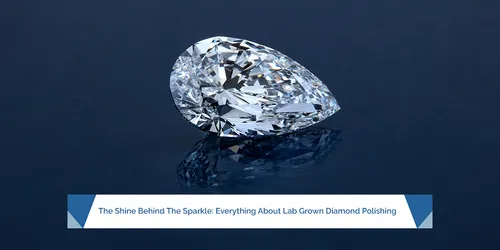
Since lab grown diamonds are environmentally-friendly and are identical to mined diamonds in physical and chemical properties; they became a challenging competitor for mined diamonds. While much has been discussed about their manufacturing in high-tech laboratories, the next stage rarely receives attention-polishing. Polishing is not a mere buffing operation; it is a precise process in which the true potential of a diamond's brilliance is realized.
In this article, we will discuss the polishing of lab grown diamonds: its importance, processes, challenges, and standards.
What Is A Lab Grown Diamond
Lab grown diamond is a lab made diamond, possessing the same chemical, physical, and optical properties. They are prepared under a well-controlled environment by advanced technological processes, basically duplication of the checks and balances within the natural diamond formation process in the bowels of the earth. There are two commonly used methods: Chemical Vapor Deposition (CVD) and High-Pressure High-Temperature (HPHT).
What Is Lab Grown Diamond Polishing
Diamonds, whether mined or lab-grown, are rough diamonds. They look like stones, unshaped. These rough diamonds need to be polished to bring in some shape, sparkle, and brilliance. So, even lab-created diamonds all need to be polished.
Importance Of Lab Grown Diamond Polishing
The polishing is the final step in the diamond cutting process for either mined or lab-grown diamonds. Polishing determines the intensity of brilliance and sparkle of a diamond through reflection and refraction of light. An inferior polish leads to the dullness of any diamond, no matter how internally perfect it may be or its origin.
Process Of Lab Grown Diamond Polishing
The polishing method for lab-grown diamonds is the same as that used for mined diamonds and includes a few key steps:
1. Planning
Before polishing commences, the rough diamond is studied in detail using a variety of software and imaging tools. The cutter makes the best determination as to the shape, size, and facet arrangement that will fetch the highest price with minimum waste.
2. Bruting
Bruting is the initial form-shaping of the diamond into a round-like form (only if it is destined to be cut as a round brilliant). It creates a basic outline by grinding one diamond against the other or by using a lathe equipped with diamond-tipped tools.
3. Faceting
However, this is where actual polishing starts. The diamond is mounted on a polishing arm or tang and placed in contact with a horizontal wheel, which rotates at high speed and is covered with diamond dust. Facets are applied in an ordered fashion, first on the crown (upper part) and then on the pavilion (bottom). Each facet must be polished at an exact angle to produce maximum visual effect.
4. Final Polishing
Once the facets are cut, they are finally polished with the use of even finer grit, which further removes any remnants of roughness or marks, increasing smoothness and shine.
At Lumex, we provide GIA Certified Lab Created Diamonds , so let’s explore Lumex.
Lab Grown Diamond Polishing Feature
Now that we have brushed over the key steps of diamond polishing, we can delve deeper into the various features of polishing synthetic diamonds.
Diamond polishing common term
Meanning
Abrasion (Abr)
Abrasion refers to areas that have small scratches or pits along the edge of the facet. An abrasive edge turns into a dull white line instead of a distinct facet junction.
Burn (Brn)
Burn (Brn) If the white haze had arisen from the heat given out during the polishing or occasionally by the flames of the jeweler, it is called a burn in the lab-created diamond polishing process.
Laser Manufacturing Remnant (LMR)
LMRs on the surface of the polished lab-created diamond are any residual marks from laser manufacturing. It usually appears as a transparent or white groove. It is only categorized as a polish mark if it does not penetrate into the diamond under 10x magnification.
Lizard skin (LS)
An irregular, clear texture constrained to one facet due to polishing at an angle different from the designed theoretical alignment.
Nick
Small indentation found along the facet junction, usually situated along the girdle or at the culet of the lab-made diamond.
Polish lines
Polish lines Parallel lines left over from polishing; these may be white (Wht) or transparent (TP). A strong transparent polish line extending from a surface-reaching feature is more precisely termed a drag line.
Tools And Technology Used In Diamond Polishing
The polishing wheel is covered in a diamond powder and oil mixture. Since diamonds are the hardest material known, it's only another diamond that can successfully polish their surfaces. Laser mapping, 3D modeling, and AI-based scanning equipment today assist technicians in gaining an unprecedented level of accuracy.
For lab-created diamonds, which tend to be grown to high clarity levels (such as VS or VVS grades), polishing equipment needs to remain highly accurate, not to introduce imperfections that might impact grading of the diamond.
How to check the quality assessment after polishing
After polishing, the engineered diamonds are inspected for quality. This involves:
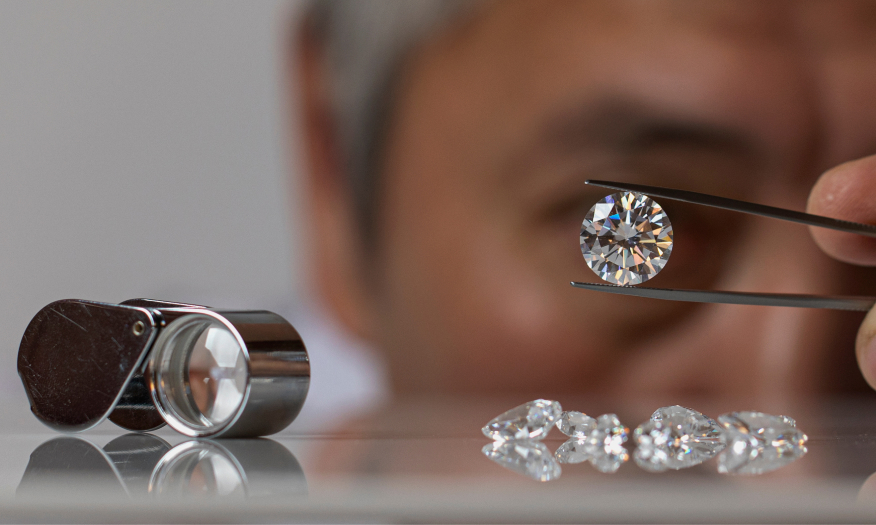
Visual examination under a 10x loupe or microscope to determine surface imperfections.
Symmetry Test to verify every facet is proportionate and aligned.
Polish Grade report, typically as part of the general grading report from gem laboratories such as GIA or IGI.
The Polish grade is usually in these ranges:
Excellent: No or hardly detectable polishing lines to the naked eye or under 10x magnification.
Very Good: Minor polish characteristics are nearly invisible.
Good/Fair/Poor: Visible polish marks which may affect brilliance.
Conclusion
Polishing is where the journey of a lab-grown diamond comes full circle to brilliance. It is a process where scientific accuracy meets human touch. From determining light performance to affecting certification grades, polishing determines how a diamond is perceived, valued, and finally worn.
For anyone who is looking at purchasing a lab grown diamond, learning about the importance of polishing facilitates an informed and appreciative decision. Behind each glint is the unseen effort of science, skill, and fine technique—this is the glint behind the glint.
Explore diamonds available through the Lumex marketplace.
Use the catalogue filters and individual diamond details to compare current availability, specifications, grading information and prices.
FEATURES FOR BUYERS
 User friendly search filters
- Memo access where enabled for an approved account
- Current prices and available promotions
- Registration terms for each account type
- Credit access where separately approved
- Grading-report details when listed for a diamond