


Blog
Step-By-Step Guide To Create Lab-Grown Diamonds
11 Dec 2025
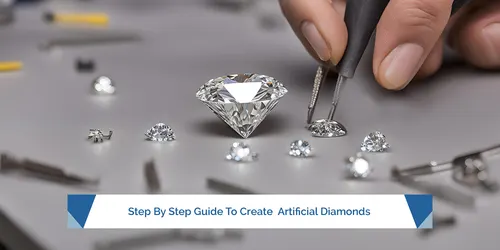
Do you want to buy a diamond but worry about the cost and availability? We have a solution to the problem, which is called a lab-grown diamond. Diamonds are always loved by women because of their natural shine and durability, but affordability is an issue. So, lab-grown diamonds have come into the market, and it is a booming industry. In this article, we have a guide on how to create lab-grown diamonds.
Generally, lab-grown diamonds are made using 2 methods: HPHT (High Pressure, High Temperature) and CVD (Chemical Vapor Deposition). Now elaborate on these two processes:
Method 1: High-Pressure High-Temperature (HPHT)
The HPHT procedure is a man-made replica of the natural environment, where diamonds are produced in the Earth's mantle at high temperatures and pressures.
Step 1: Preparation:
A tiny diamond seed, a carbon source (usually pure graphite), and a metal catalyst (usually iron, nickel, or cobalt) are put into a specially designed growth capsule within a giant press.
Step 2: Extreme Conditions:
The capsule is exposed to super high temperatures (about 1,300ºC to 1,600ºC) and ultra-high pressure (up to 870,000 psi or even more).
Step 3: Growth:
The high temperature causes the metal catalyst to melt, dissolving the surrounding carbon source. This carbon then crystallizes around the diamond seed, creating a larger lab-grown diamond rough layer by layer.
Step 4: Cooling and Extraction:
This whole process takes days to weeks. Afterward, the chamber is allowed to cool slowly, and the rough lab-grown diamond is carefully removed.
Method 2: Chemical Vapor Deposition (CVD)
Diamonds produced using the CVD method are created layer by layer in a vacuum chamber and are often regarded as a less power-consuming process compared to HPHT.
Step 1: Preparation:
A diamond seed slice is placed inside a closed vacuum chamber.
Step 2: Gas Introduction and Heating:
Carbon-rich gases (such as methane and hydrogen) are introduced into the chamber, and the temperature is raised to between 800ºC and 900ºC.
Step 3: Plasma Creation:
The gases are ionized using microwaves, lasers, or hot filaments, breaking molecular bonds and forming a glowing plasma cloud.
Step 4: Growth:
The carbon atoms released in the plasma settle onto the diamond seed and bond with its crystal structure, growing the lab-grown diamond layer by layer.
Step 5: Cooling and Extraction:
The CVD diamonds growth process lasts several weeks. Once completed, the chamber is cooled, and the raw lab-grown diamond—typically square-shaped—is removed.
Final Step of the Lab-Grown Diamonds Finishing Process
Rough Diamond:
After growth, a rough lab-grown diamond emerges.
4C’s of Diamond:
The quality of the lab-grown diamond is evaluated using the 4Cs—cut, clarity, carat, and color. The rough diamond is then polished into a finished gemstone.
Certification:
All Lumex lab-grown diamonds are certified by GIA.
Difference between HPHT and CVD
Conclusion
In conclusion, creating lab-grown diamonds is a blend of advanced science and technology. The two main methods—HPHT and CVD—use highly purified carbon sources to produce diamonds that match natural diamonds in brilliance and durability. From seed preparation to controlled growth, cutting, and polishing, each step ensures that lab-grown diamonds rival mined diamonds in beauty and quality.
Explore diamonds available through the Lumex marketplace.
Use the catalogue filters and individual diamond details to compare current availability, specifications, grading information and prices.
FEATURES FOR BUYERS
 User friendly search filters
- Memo access where enabled for an approved account
- Current prices and available promotions
- Registration terms for each account type
- Credit access where separately approved
- Grading-report details when listed for a diamond