


Blog
Key Factors That Influence The Price Of Lab Grown Diamond
07 Nov 2025
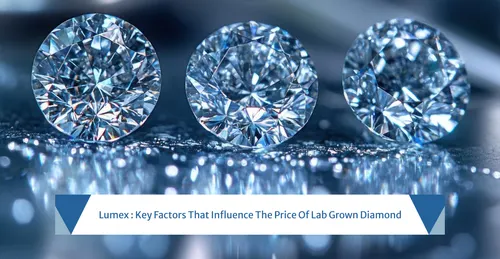
In recent years, lab-grown diamonds have taken the jewelry world by storm. Buyers in the modern era have preferred them due to one reason: they are identical in sparkle, chemical structure, as well as brilliance to mined ones, while being less expensive. The confusion regarding the pricing of lab diamond when it comes to gifting an engagement ring or pendant necessitates a judgment call.
Elements Affecting the Price of Lab Grown Diamond
Price Of Lab Grown Diamond depends on the various factor such as :
The 4c Factor
Mined diamonds are graded according to the 4Cs — Cut, Color, Clarity, and Carat Weight. Lab-grown diamonds are classified in the same way. Together, these four factors determine a diamond’s quality, attractiveness, and price.
Cut
The cut of a diamond indicates not its shape but rather how light is reflected by it. A diamond that has a good cut emits more light and looks more alive. That is the case with lab-grown diamonds rated as excellent or ideal cut; their price is higher because they not only reflect light beautifully, but also make the diamond look better overall.
Color
There is a range of color grades for diamonds, from D (colorless) to Z (light yellow or brown). A colorless diamond is considered to be the most rare and expensive. Natural diamonds can be very rare in terms of color and therefore expensive; however, synthetic diamonds can be developed with almost perfect color, which makes it easier to get a higher-grade diamond at a lower price than a natural one.
Clarity
Clarity is defined as the degree to which a diamond is free of internal or external flaws—the latter being termed as inclusions and blemishes. Diamonds produced in a laboratory are often less flawed since they grow in a controlled environment. It is less; the diamond is clearer and more radiant. The most significant point is the price, of course, the highest one being it.
Carat Weight
The unit of carats measures the weight and dimensions of the diamond. The price goes up along with the size of the diamond because larger ones are less common, and getting them entails more time and use of capital resources. Still, being artificially produced, the diamonds do not necessitate the same outrageously high prices that come along with the quality of mined ones; thus, a customer is free to pick a larger piece without paying extra for it.
Note: Get a Complete Guide of lab grown diamond price in India
Growing Method
The production of lab-grown diamonds is based on two primary methods: CVD (Chemical Vapor Deposition) and HPHT (High Pressure High Temperature). The choice of the method affects only the cost and quality of the diamond to some extent, as both lead to the formation of real diamonds.
CVD Diamonds
In the CVD process, the diamond seed is gradually covered with carbon atoms in a vacuum chamber. This method gives strong control over the growth of the diamond and thus produces stones with great clarity and fewer inclusions.
The increasing acceptance of CVD diamonds is mainly due to their high optical quality and low price.
HPHT Diamonds
The HPHT process replicates the Earth’s natural creation of diamonds by subjecting carbon to extreme heat and pressure to generate a diamond. These diamonds are sometimes a bit pricier since the method can create stones of very high purity, but some might have a slight yellow color due to the presence of nitrogen impurities.
Typically, CVD diamonds are more expensive than HPHT diamonds, but they are also better at the same time in terms of quality and size.
Note: Get a Complete Guide of lab grown diamond cost in USA
Certification
A certificate from a reliable gemological laboratory, like IGI or GIA, should accompany every diamond, natural or lab-grown. This certification gives a trustworthy evaluation of the diamond in terms of its 4Cs and sources, and thus, it gives confidence to the buyer and, in many cases, a higher price tag as compared to non-certified diamonds. Therefore, always demand certification when purchasing a lab-grown diamond to be sure you have a worthy deal for your purchase.
Brand Value
The brand or jeweler is decreasing the price of a lab-grown diamond, while the established jewelers charging more support it with their reputation and quality assurance. Premium brands are cutting with the finest technique, and so are the others; thus, the smallest two have the lowest price, but they do not cut that finely, and also do not have that good after-sales service. Therefore, when comparing prices, consider the added value of trust, quality, and craftsmanship.
Technology Advancement
Along with the diamond-growing technology, the production efficiency of lab-grown diamonds keeps improving, and so does their quality and cost. Automation, AI, and laser cutting techniques are some of the manufacturing processes that enhance the quality of lab-grown diamonds, enabling them to match or even surpass the mined diamonds in beauty and purity, thus making them luxurious as well as affordable.
Note: Get a Complete Guide of lab grown diamond price in Dubai
Conclusion
Lab grown diamonds offer an affordable and sustainable alternative to natural diamonds, balancing beauty, technology, and responsibility. Their price is influenced by factors such as the 4Cs, growth method, certification, and craftsmanship. Ideal for celebrating love, success, or personal style, they enable a responsible approach to elegance. And for all your lab-grown diamond needs, Lumex is a trustworthy manufacturer and exporter standing by the quality and expertise you can rely on.
Explore diamonds available through the Lumex marketplace.
Use the catalogue filters and individual diamond details to compare current availability, specifications, grading information and prices.
FEATURES FOR BUYERS
 User friendly search filters
- Memo access where enabled for an approved account
- Current prices and available promotions
- Registration terms for each account type
- Credit access where separately approved
- Grading-report details when listed for a diamond